
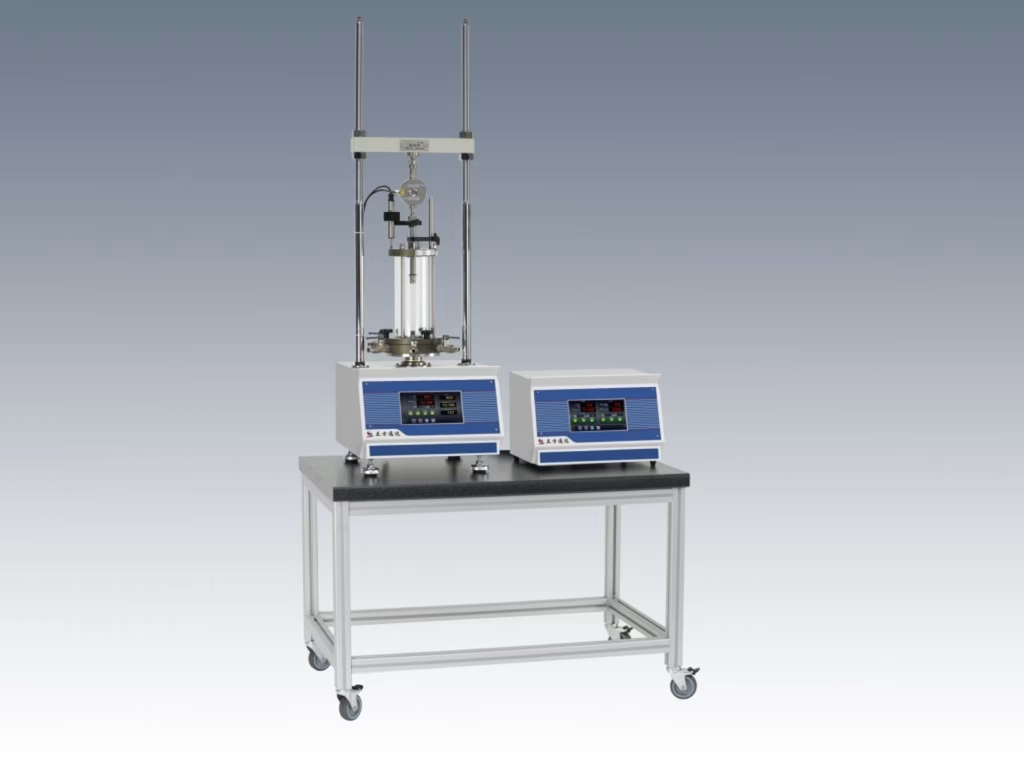
The triaxial compression test is the most versatile strength test in the geotechnical laboratory: it takes a cylindrical soil specimen, wraps it in a rubber membrane, subjects it to a controlled confining fluid pressure inside a transparent cell, and then loads it axially until it fails. Because both the confining stress and the axial stress are known and controlled, the test produces the complete stress-strain curve and lets the engineer back out the shear strength parameters that enter slope stability, foundation bearing and embankment design. Two of the most commonly specified variants are the consolidated-undrained test with pore-pressure measurement, covered by ASTM D4767, and the consolidated-drained test, covered by ASTM D7181. This article explains how the triaxial cell works, how CU and CD tests differ, what the resulting effective stress parameters mean, and what to look for when buying a triaxial test system.
A standard triaxial specimen is 50 or 100 mm in diameter, with a height-to-diameter ratio of about 2. In the test it is sealed in a thin latex membrane between two metal end caps and placed inside a chamber filled with water or glycerine. The chamber fluid is pressurised to a chosen confining stress, sigma3, which acts equally on all sides of the specimen. A piston through the cell base then applies an increasing vertical load, the deviator stress sigma1 minus sigma3, while axial deformation and, where fitted, pore-water pressure and volume change are recorded. Plotting the principal stresses at failure on a Mohr circle and drawing the common tangent to at least three circles at different confining stresses gives the Mohr-Coulomb strength envelope, described by cohesion c and friction angle phi. The power of the test is that drainage can be opened or closed at the specimen ends at any stage, which is exactly what separates UU, CU and CD testing.
The letters describe whether the specimen is allowed to consolidate under the confining stress, and whether it is drained while being sheared. The unconsolidated-undrained test, ASTM D2850, applies the confining pressure and shears without drainage at either stage, giving total-stress undrained strength used for short-term or rapid loading conditions. The consolidated-undrained test per D4767 consolidates the specimen fully under sigma3 with drainage open, then shears with drainage closed while measuring pore pressure, so that both total-stress strength and effective-stress parameters can be derived. The consolidated-drained test per D7181 keeps drainage open during both consolidation and slow shearing, so that no excess pore pressure develops and the measured strength is directly the effective-stress strength c’ and phi’. The table below summarises the practical differences.
| Feature | UU (ASTM D2850) | CU (ASTM D4767) | CD (ASTM D7181) |
|---|---|---|---|
| Drainage during consolidation | Closed | Open | Open |
| Drainage during shearing | Closed | Closed | Open |
| Pore pressure measured | No | Yes | Not needed |
| Strength parameters | Total stress (cu, phi_u = 0 often) | Total and effective (c’, phi’) | Effective (c’, phi’) |
| Typical shearing rate | Relatively fast | Moderate (e.g. 0.5 to 2 % strain/h per D4767 guidance) | Very slow (longest test) |
| Main use | Short-term stability, simple field screening | Most design work; rapid and pore-pressure aware | Long-term stability, slow drained loading |
- Trim the specimen, check diameter and height, and weigh it; mount it on the base pedestal with porous stones, filter paper and a latex membrane sealed by O-rings.
- Assemble the cell, fill it with de-aired fluid, and apply an initial small confining pressure.
- Saturate the specimen, usually by flushing de-aired water through the drains and, for fine-grained soils, by back-pressuring to raise the Skempton B value. A B value of at least 0.95 is commonly required before effective-stress results are trusted.
- Consolidate the specimen isotropically to the chosen effective confining stress sigma3 prime, keeping the drainage lines open until volume change stabilises.
- Close the drainage valves, start the axial loading at a strain rate slow enough that measured pore pressure equilibrates but fast enough to complete the test in a reasonable time, and record axial load, strain and pore pressure continuously.
- Continue through the peak or to the prescribed axial strain, then unload, dismantle, extrude the specimen, measure the water content and check the failure surface.
Because consolidation has already taken place, the CU test gives the strength of the soil once it has finished settling under the confining stress, while the pore-pressure measurement lets the designer convert the measured total stresses into effective stresses for the actual drainage conditions of the project. This is why the CU test is the workhorse test for most slope and foundation investigations.
Note: back-pressure saturation is not optional work for weak, saturated fine-grained soils. A specimen that is only partially saturated will give a misleadingly low B value, and its effective-stress strength parameters will be optimistic; always record the final B value on the test sheet.
In the consolidated-drained test the specimen is consolidated exactly as in the CU test, but during shearing the drainage lines remain open. The shearing rate must then be slow enough that any excess pore pressure generated by the straining can dissipate immediately; for low-permeability clays this can mean tests lasting days rather than hours. The reward is simplicity of interpretation: because no excess pore pressure develops, the effective stresses equal the total stresses, and the Mohr-Coulomb envelope drawn from the failure circles directly yields c’ and phi’. With drainage open, the volume change of the specimen is also measured during shear, giving the dilatancy behaviour of dense sands and overconsolidated clays that controls volume change around foundations. For sands and gravels, drained tests are practical because permeability is high; for soft clays, engineers often prefer the CU test plus pore-pressure measurement as the efficient route to the same effective parameters.
The output that matters for long-term design is the effective stress shear strength, written as tau_f = c’ + sigma’ tan phi’. The effective cohesion c’ reflects true bond or cementation plus the intercept the envelope needs, while the effective friction angle phi’ reflects the interparticle sliding resistance. Typical figures quoted in textbooks and practice are phi’ of about 30 to 40 degrees for dense sands, 20 to 30 degrees for normally consolidated clays, and c’ values that are small or taken as zero for clean sands; always use values measured on the project’s own soils, because borrow material and weathering shift these numbers. These parameters feed slope stability analyses under drained conditions, the long-term stability of embankments and cuts, bearing capacity for foundations on saturated soils after consolidation, and the effective-stress checks in retaining wall design. The consolidation data from the test, together with oedometer results, also support settlement estimates.
| Symptom | Likely cause | Check / corrective action |
|---|---|---|
| Scattered, non-reproducible c’ and phi’ | Incomplete saturation (low B value) | Repeat saturation and back-pressure; confirm B at least 0.95 before shear |
| Pore pressure response lagging behind load | Shearing rate too fast or blocked drains | Slow the strain rate; flush drains and check for membrane leaks |
| Strength far above neighbouring specimens | Membrane restraint on a soft specimen, or over-consolidation | Apply membrane correction; verify sigma3 consolidation level |
| Volume change reading drifting | Air trapped in drainage lines or leaky valves | De-air the lines; pressure-test the apparatus and O-rings |
| Failure at the cap or base instead of a clean shear plane | End platen friction or specimen misalignment | Use lubricated end platens; re-align the specimen and piston |
A complete system has four sub-assemblies: the load frame, the cell, the pressure control, and the measurement chain. The load frame must give a steady strain rate and accurate axial load indication, commonly verified to a force-measurement standard such as ASTM E4, with a 10 kN or higher capacity for ordinary soils and more for weak rocks. The cell should accept 50 and 100 mm specimens with interchangeable bases, and the confining pressure range should match the project stresses, often up to 1.0 or 1.7 MPa. Pressure control is the heart of good results: manual mercury or burette systems are being replaced by digital pressure/volume controllers that set sigma3, apply back pressure and measure volume change with precision, while a separate differential pressure transducer captures pore pressure. The load measurement chain, load cell, displacement transducer and pore-pressure transducer all need regular calibration, and data logging that plots stress-strain and stress paths live saves hours of reworking. Materst, drawing on 24 years of anti-corrosion engineering heritage and a dedicated production base, supplies triaxial apparatus with digital pressure and pore-pressure control together with complete geotechnical laboratory packages for soils testing laboratories worldwide.
The triaxial test earns its central place in geotechnical design because it reproduces, in the laboratory, the actual drainage and stress conditions that a soil will meet in the ground. The UU, CU and CD variants are not interchangeable; each answers a different design question, and choosing the right one depends on whether the engineering situation is short-term or long-term. Run the saturation and B-value checks properly, match the shearing rate to the drainage path, calibrate the pressure and load chain, and the test will deliver the c’ and phi’ values that make slope and foundation designs defensible for decades.
Sources and references
- ASTM D4767, Standard Test Method for Consolidated Undrained Triaxial Compression Test for Cohesive Soils — ASTM International
- ASTM D7181-20, Standard Test Method for Consolidated Drained Triaxial Compression Test for Soils — ASTM International
- ASTM D2850, Standard Test Method for Unconsolidated-Undrained Triaxial Compression Test on Cohesive Soils — ASTM International
- ASTM Subcommittee D18.05 on Strength and Compressibility of Soils (current standards list)