
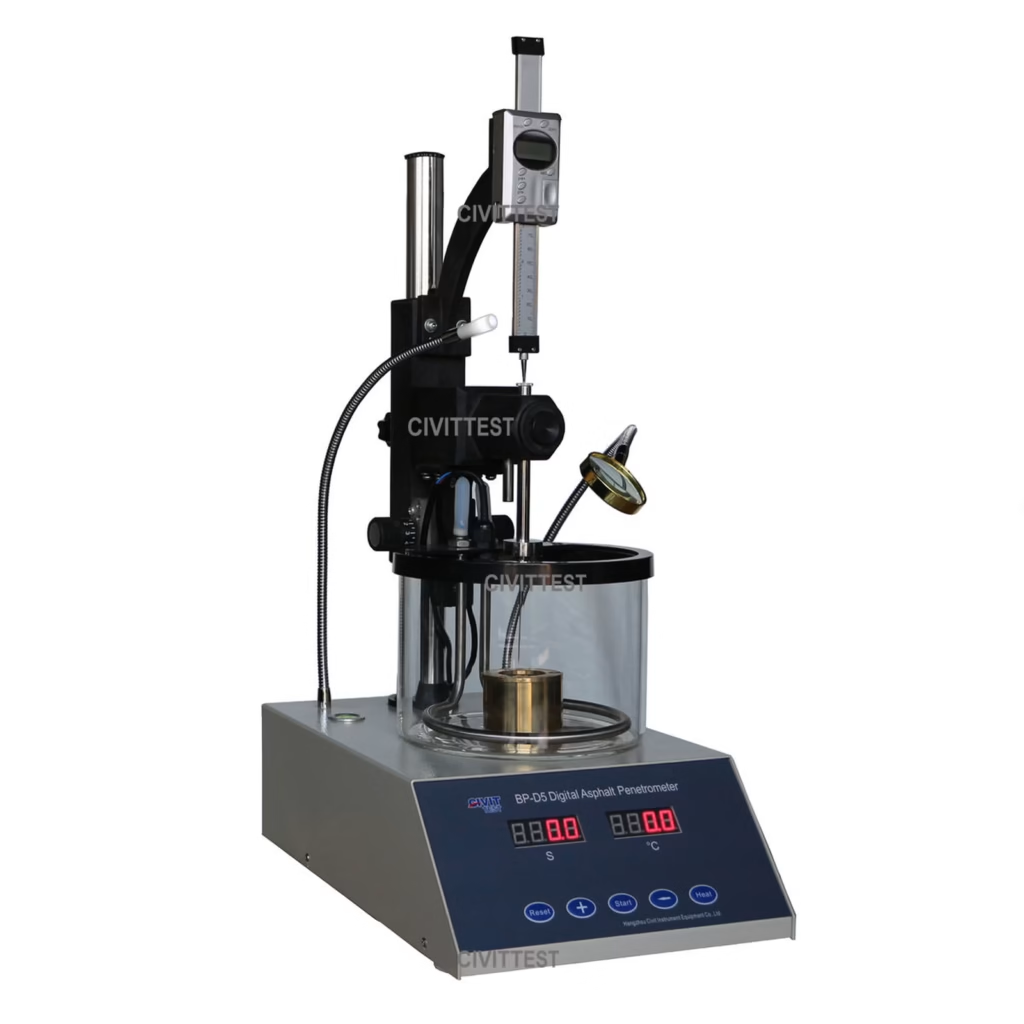
The bitumen penetration test is the oldest and still the most widely used empirical measure of binder consistency: it measures how far a standard hardened steel needle sinks into a sample of semi-solid bitumen under a fixed load, for a fixed time, at a fixed temperature. The result, reported in units of 0.1 mm, defines the penetration grade of paving bitumens worldwide, and it is the single property that tells a specifier whether a given binder is hard enough for a hot-climate road or soft enough for a cold one. This guide explains the method as defined by ASTM D5/D5M and the European equivalent EN 1426, what the penetration numbers mean for climate selection, the errors that silently invalidate results, and the points to check when choosing a penetrometer.
Penetration is the depth, expressed in tenths of a millimetre, that a standard needle penetrates vertically into a bitumen sample under specified conditions. Under the commonly used standard conditions of 100 g total load, 5 s duration and 25 °C, a grade 80/100 binder will typically let the needle sink 80 to 100 units, while a grade 40/60 binder will stop it at 40 to 60. A softer binder, with a higher penetration number, flows more easily and is more deformable; a harder binder resists deformation at high temperature but becomes brittle and crack-prone when cold. The test is therefore a consistency index, not a viscosity, and it must be read at the exact conditions it was designed for, because both temperature and load change the result dramatically. The scope of the test, as published by ASTM, covers semi-solid and solid bituminous materials and provides for penetrations up to 500; the European method per EN 1426 likewise applies the routine procedure up to 330 x 0.1 mm, with a modified procedure for higher values.
The reproducibility of penetration depends almost entirely on geometry and temperature control, which is why the standards fix them so tightly. The needle is made of hardened, tempered and polished steel, cylindrical and flattened to a specific taper, with a mass of 2.5 g, and it slides in a holder so that the total mass of needle plus holder acting on the sample is 100 g. The test is normally run with the specimen immersed in a water bath held at 25.0 ± 0.1 °C: the needle is brought gently to the surface of the binder, released for exactly 5 s, and the depth of penetration read from the dial or digital displacement gauge. The sample container is a flat metal or glass dish of specified diameter and depth, so that the bitumen layer is thick enough that the needle never reaches the bottom during the test. For research or special grading work, other temperatures such as 15 °C or 5 °C are used to characterise the binder at colder service conditions, and the penetration values at more than one temperature feed the calculation of the penetration index.
Bitumen is heated carefully until it is sufficiently fluid to pour, taking care not to overheat it, which ages the binder and hardens it. The molten sample is poured into the standard sample dish to a depth that leaves the required bitumen layer thickness, then cooled in the laboratory atmosphere for between 60 and 90 min, shielded from dust. The dish and its sample are then placed in the constant-temperature water bath, normally at 25.0 °C, for a further 60 to 90 min before testing. This conditioning interval is not optional: a sample that has not reached bath temperature throughout its thickness will read artificially low penetration when the surface is colder than the core, and the standards require the bath itself, with the specimen in it, to be held at the test temperature for the conditioning period. During the test, the specimen dish remains in the bath, and the penetrometer is positioned so that the needle drops vertically, away from the edge of the dish and away from any previous test points, because each depression left by an earlier needle changes the surface the next reading is taken from.
Paving bitumens are sold by penetration grade, written as the range of acceptable penetration values. The grade number is the bridge between a laboratory test and a pavement design decision: harder grades, with lower penetration numbers, are chosen for hot climates and slow, heavy-traffic roads where rutting is the dominant risk, while softer grades are chosen for cold climates where thermal cracking governs. The table below lists the common grades used in European and national penetration specifications and their typical field of application; exact limits and approved grades are always set by the governing project specification, and national standards differ on which grades are in the product range.
| Grade | Penetration at 25 °C (0.1 mm) | Typical application / climate |
|---|---|---|
| 20/30 | 20–30 | Very hard binder for mastic asphalt and heavily loaded surface courses in hot climates |
| 30/45 | 30–45 | Hard binder, hot climates, high-traffic roads and industrial pavements |
| 40/60 | 40–60 | Warm to hot climates, surface and binder courses on heavily trafficked roads |
| 50/70 | 50–70 | Warm temperate climates, general-purpose road binder |
| 60/70 | 60–70 | Common North American and temperate-climate paving grade |
| 70/100 | 70–100 | Temperate climates, binder and base courses, less demanding traffic |
| 80/100 | 80–100 | Temperate to cool climates, general paving use |
| 160/220 | 160–220 | Soft binder for cold climates, surface courses and slurry seals |
Penetration also enters specifications through the penetration index, which combines the penetration at 25 °C with the softening point from the ring-and-ball test to express the temperature sensitivity of the binder. A normal unmodified paving bitumen has a penetration index roughly between -1 and +1; binders with a lower index harden and embrittle rapidly as they cool, which points to cracking risk, while polymer-modified binders are formulated to keep the index within a narrower, more stable band. Because the index depends on two standard tests, a penetrometer that drifts in temperature or timing corrupts not only the penetration result but also the derived index.
Penetration results are sensitive enough that experienced laboratories run at least three determinations per sample and reject the dish if the readings scatter beyond the precision stated in the standard. The most frequent faults are summarised below; in practice, the bath thermometer and the release timing device cause more inter-laboratory disagreement than the penetrometer itself.
| Symptom | Likely cause | Check / corrective action |
|---|---|---|
| Readings run consistently low (binder appears too hard) | Bath temperature below 25 °C or inadequate conditioning time | Verify bath reads 25.0 ± 0.1 °C; confirm 60–90 min conditioning after pouring |
| High scatter between repeated readings | Needle not perpendicular, needle tip touching the sample dish bottom, or re-use of indented points | Check needle holder alignment; choose fresh points on the surface; verify dish depth and bitumen layer thickness |
| Readings drift over the day | Needle contamination with bitumen, a bent or damaged needle, or timer drift | Clean the needle tip with solvent and lint-free tissue after each use; inspect the needle for damage; check the timing device against a reference |
| Same binder reads differently between two laboratories | Load assembly not 100 g total, or release mechanism adds a jolt | Verify total mass of needle and holder; check that the needle is released freely without lateral movement |
| Sample appears aged after testing | Overheating during pouring | Heat the binder only to the temperature needed for pouring; avoid prolonged heating above the mixing temperature |
Warning: the needle must be released, not pushed. Any hand pressure on the holder during release, or a stiff release mechanism that drags the needle sideways, invalidates the reading; this is the most common beginner mistake and it is invisible in the written record unless the laboratory notes the operator.
A penetration laboratory needs four core items: a penetrometer with a vertical guide and a displacement readout, a set of standard needles and 100 g load weights, an accurate timing device, and a thermostatically controlled water bath that holds 25.0 ± 0.1 °C. Entry-level mechanical instruments use a dial gauge; modern digital penetrometers display the penetration value directly, hold the last reading and often integrate the timer so that the 5 s interval is automatic rather than counted by the operator. For commercial or plant laboratories that test samples in batches, the digital automatic timer and an electronic readout are worth the upgrade, because operator timing error is the largest avoidable variable in the test. Verify that the apparatus can accommodate the standard sample dishes and that the needle holder accepts standard needles, so that consumables from any supplier are interchangeable. Materst supplies digital bitumen penetrometers together with standard needles, sample dishes and constant-temperature baths for binder testing laboratories, covering the equipment needs of penetration, softening point and ductility testing stations.
Penetration has survived more than a century of bitumen testing because it is simple, fast and directly tied to the grade names printed on every binder delivery note. But its simplicity hides a precision test: 0.1 °C of bath error and half a second of timing error both move the number, and a bent or contaminated needle ruins the dish. Run the standard conditions exactly, condition the sample fully, clean the needle between readings, and read the penetration grade against the climate the pavement will actually serve, and the penetrometer remains the most reliable entry point to binder acceptance and mix design.
Sources and references
- ASTM D5/D5M-20, Standard Test Method for Penetration of Bituminous Materials — ASTM International
- Eurobitume Technical Information: Needle Penetration per EN 1426 (bitumen and bituminous binders)
- EVS-EN 1426:2007, Bitumen and bituminous binders — Determination of needle penetration (scope, Estonian Centre for Standardisation)