Air content is one of the few fresh-concrete properties that directly predicts how durable the hardened concrete will be in a freezing climate. Too little entrained air and saturated concrete will scale, crack and deteriorate after a handful of winter freeze-thaw cycles; too much and the strength drops sharply for no durability benefit. The test […]
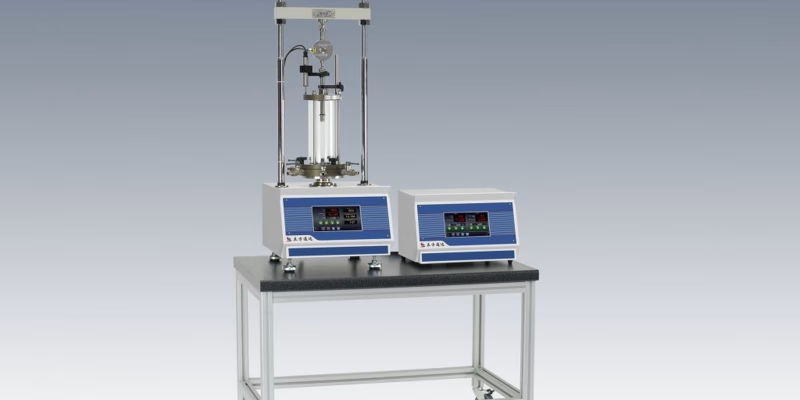
The triaxial compression test is the most versatile strength test in the geotechnical laboratory: it takes a cylindrical soil specimen, wraps it in a rubber membrane, subjects it to a controlled confining fluid pressure inside a transparent cell, and then loads it axially until it fails. Because both the confining stress and the axial stress […]
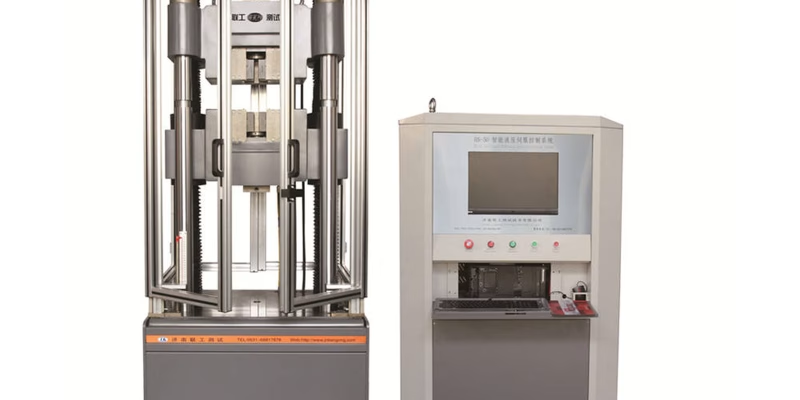
A universal testing machine (UTM) is the workhorse of any materials laboratory: a single frame that pulls, pushes, bends and shears specimens from metals, plastics, rubber, textiles, composites, concrete and geotextiles. Choosing the wrong frame is expensive — too small and it cannot test your largest specimen; too large and the load cell loses accuracy […]
Compressive strength is the single most reported property of hardened concrete, and the test for it is the gate through which every concrete mix must pass before a structure is accepted. A standard cylinder or cube is loaded axially to failure in a compression testing machine, and the peak load divided by the cross-sectional area […]
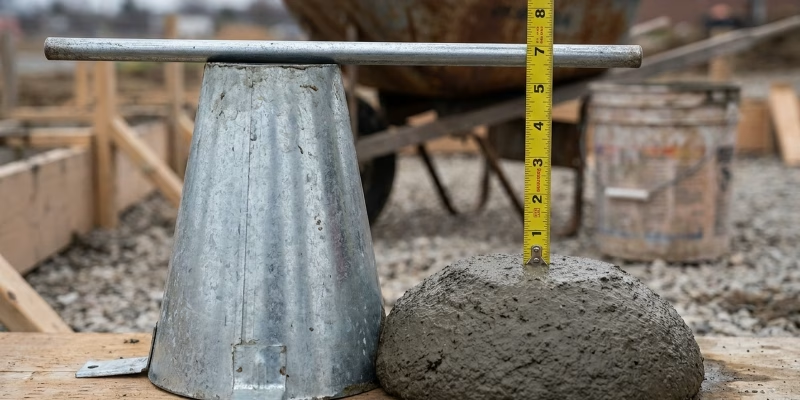
The slump test is the fastest, cheapest and most widely used field check on the consistency of fresh concrete. A sample of concrete is filled into a standard truncated cone, rodded in layers, and the cone is lifted straight off; the distance the concrete subsides vertically is the slump, reported in millimetres. It takes a […]
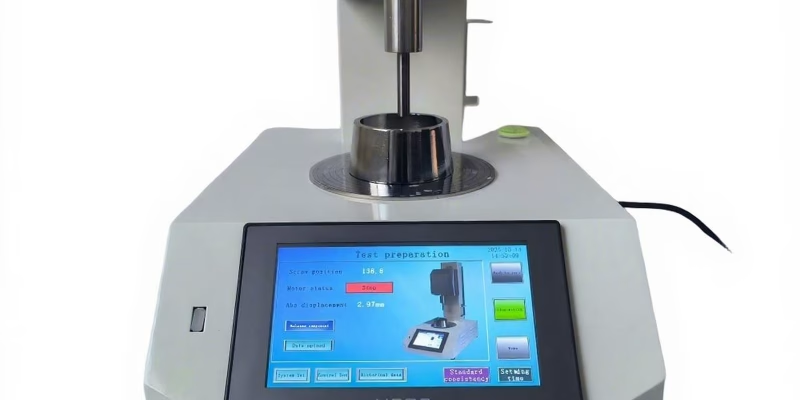
The Vicat apparatus is the standard instrument for measuring how quickly a cement paste changes from a fluid, workable condition to a rigid one. It does not measure strength directly; it measures the moment at which the hydration of the cement has produced enough cohesion that a weighted needle can no longer sink freely into […]
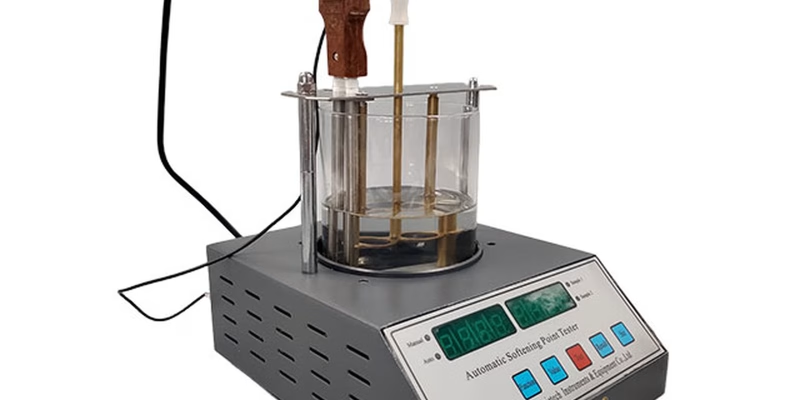
The softening point of a bitumen is the temperature at which the binder becomes soft enough, on heating, to deform under a small load. It is measured with the ring-and-ball apparatus: two discs of bitumen cast in brass rings are each loaded with a steel ball, and the assembly is heated in a liquid bath […]
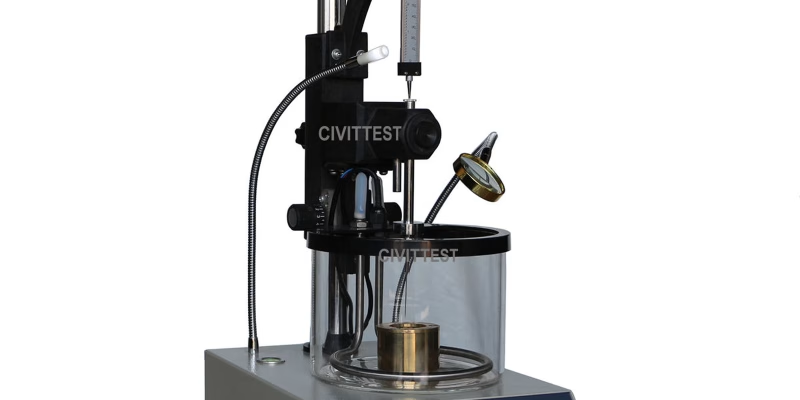
The bitumen penetration test is the oldest and still the most widely used empirical measure of binder consistency: it measures how far a standard hardened steel needle sinks into a sample of semi-solid bitumen under a fixed load, for a fixed time, at a fixed temperature. The result, reported in units of 0.1 mm, defines […]
Rutting, the permanent deformation of an asphalt pavement along the wheel path, is among the most visible and most damaging distresses on heavily trafficked roads in hot climates. It does not only shorten pavement life; deep ruts trap water, reduce tyre grip and make steering less predictable, which is why rutting resistance is a mandatory […]
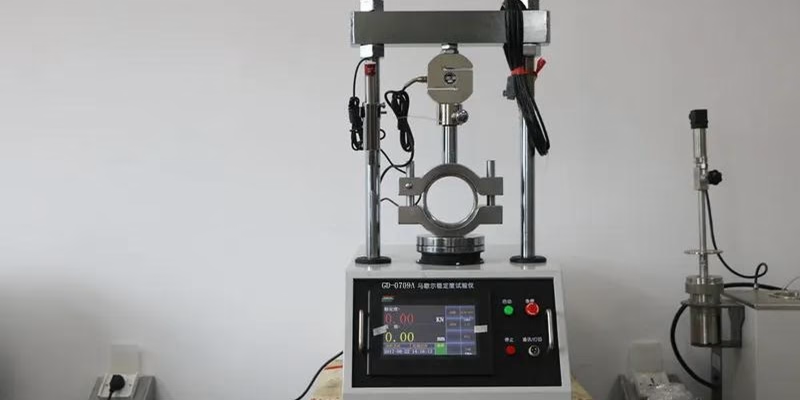
The Marshall stability test measures the maximum load a compacted asphalt specimen can resist before failure and the vertical deformation, or flow, it undergoes at that load. Together those two numbers have decided the acceptance of dense-graded asphalt mixes in laboratories around the world for more than seven decades. For mix design laboratories, plant quality […]