
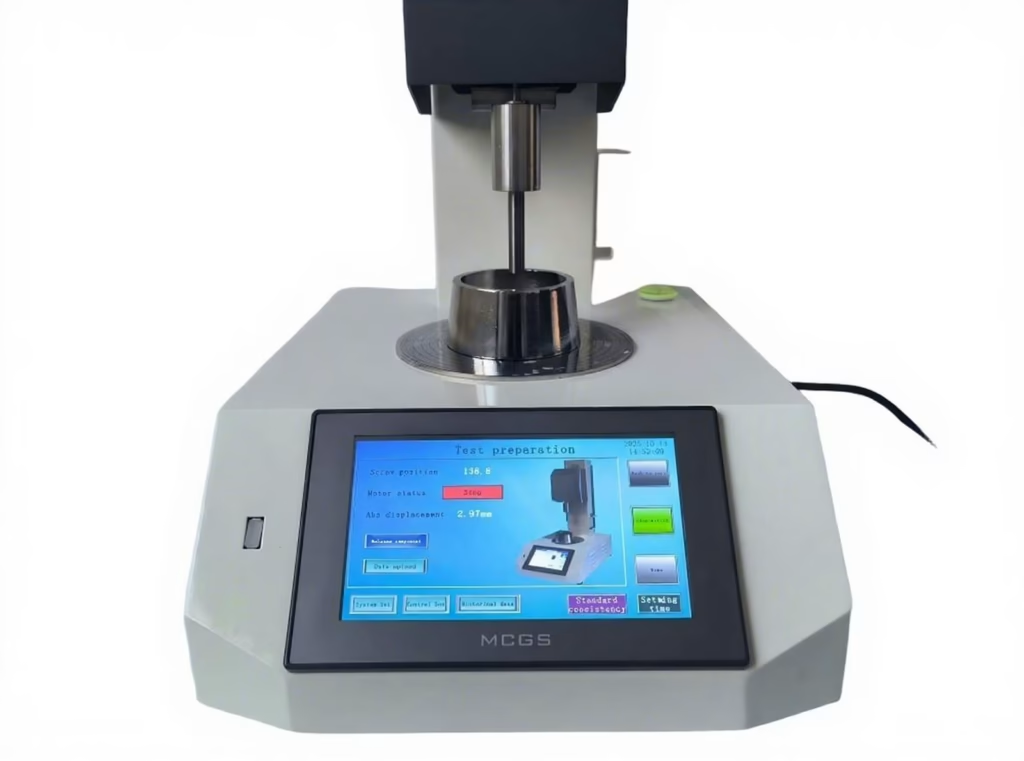
The Vicat apparatus is the standard instrument for measuring how quickly a cement paste changes from a fluid, workable condition to a rigid one. It does not measure strength directly; it measures the moment at which the hydration of the cement has produced enough cohesion that a weighted needle can no longer sink freely into the paste. Two instants matter in construction: the initial set, after which the concrete or mortar can no longer be placed, compacted or finished, and the final set, after which the paste has gained enough rigidity to be left undisturbed. Both are fixed on the clock starting the moment water first touches the cement, which is why the test is central to concrete delivery scheduling, transport limits and formwork stripping. This guide covers the method defined by ASTM C191 and the parallel European method EN 196-3:2016, the need for a standard-consistency paste, the needle criteria, typical values, common errors and what to look for when buying a Vicat machine.
The apparatus consists of a rigid frame, a rod free to slide vertically through a collar, a removable needle or plunger screwed into the lower end of the rod, and a mould with a glass or metal base plate. The rod carries a total mass of 300 g so that the needle sinks into the paste under a known, reproducible load. As the cement hydrates, the paste stiffens and the penetration of the needle into the paste decreases with time. The test simply repeats that penetration measurement at intervals and records the clock times at which two penetration thresholds are crossed. ASTM C191 gives two test methods: Method A is the reference test using the manually operated standard Vicat apparatus, while Method B allows an automatic Vicat machine that has demonstrated equivalent and qualified performance under the standard.
Setting time is meaningless unless the paste has a fixed water content, because more water makes the paste flow longer and less water makes it set faster. Before any setting measurement, the laboratory first determines the water content that produces a standard-consistency paste: a paste of fixed, reproducible stiffness. In practice, a series of trial pastes with increasing water percentages is prepared and each is tested with the 10 mm diameter Vicat plunger; the standard-consistency water is the percentage at which the plunger sinks to a prescribed depth, typically 6 ± 1 mm from the base of the mould per EN 196-3. All setting-time determinations are then run on a paste mixed with exactly that water content, so that cements from different sources and different laboratories can be compared on a like-for-like basis.
Note: the water content for standard consistency is typically around 25–30% of the cement mass for ordinary Portland cement, but the exact percentage must be found by trial for each cement batch; do not assume a fixed value and skip the consistency determination.
The setting needle is a straight, rigid steel needle about 50 mm long and 1.13 mm in diameter, screwed into the 300 g rod. The test is performed by gently lowering the needle until it touches the paste surface and then releasing it, waiting a few seconds, and reading how far it penetrated. The two end points are:
- Initial set: the time, measured from the moment water first contacts the cement, at which the needle no longer penetrates the paste to the reference depth. Under ASTM C191 the reference is a penetration of 25 mm measured from the top of the mould; under EN 196-3 the equivalent criterion is stated as the needle sinking to within a fixed distance of the mould base. Near the end point the interval between successive needle readings is shortened, because the penetration changes quickly.
- Final set: the later time at which the needle, usually fitted with an annular attachment so that it leaves a circular mark, fails to sink visibly into the surface and leaves no complete circular impression. This is the moment the paste has become rigid enough to carry its own shape without further measurable plastic deformation.
Both times are reported to the nearest minute or, near the end point, to the nearest quarter hour, and they are always reported together with the cement identity, the consistency water percentage, the laboratory temperature and the standard used.
Initial set defines the working life of the concrete: it caps the maximum time allowed for transport, placement, compaction and finishing. A concrete truck delayed in traffic, a pumped pour that takes longer than planned, or a large floor slab that needs hours of finishing all run against the initial set time of the cement in the mix. Final set is the earliest practical moment at which surface finishing, trowelling, stressing or loading may begin and is used to estimate formwork striking times and curing schedules. Specifying minimum initial set and maximum final set times, as the cement product standards do, is what makes a cement predictable enough for a programme. Cement that sets too fast will not reach the site; cement that sets too slowly keeps forms occupied and delays the next trade.
The cement product standards set acceptance limits, and ordinary cements normally fall well inside them. The figures below are typical guidance values; the governing cement specification and the job mix specification always take precedence.
| Cement type | Initial set (typical limit) | Final set (typical limit) |
|---|---|---|
| Ordinary Portland cement (per EN 197-1 common cement) | ≥ 75 min | ≤ 12 h |
| ASTM C150 Type I/II general-purpose cement | ≥ 45 min | ≤ 375 min (6.25 h) |
| Rapid-hardening / early-strength cement | ~1–2 h (faster than OPC) | ~3–4 h |
| Sulfate-resistant or blended cement (PFA, GGBS) | Often slower, ~2–4 h | Often ~5–8 h |
| Typical measured OPC in a 20 °C lab | 2–3 h | 4–6 h |
A Vicat result only reflects the cement if the test conditions are controlled. The main influencing factors are:
- Fineness: finer cement has more surface area, hydrates faster and sets earlier.
- Temperature: higher paste and air temperatures accelerate hydration; colder temperatures slow it, which is why the standard calls for testing at about 20 °C.
- Gypsum and alkali content: the sulfate added to control C3A reaction and the alkali level shift both the initial and final set.
- Admixtures: accelerators (such as calcium chloride) shorten the set; retarders, some water reducers and many supplementary cementitious materials lengthen it.
- Water content and paste age: extra water delays the set, and a surface that dries out gives a falsely early final set.
| Symptom | Likely cause | Check / corrective action |
|---|---|---|
| Set time inconsistent between batches | Consistency water not redetermined for each cement lot | Run the 10 mm plunger consistency trial on every new batch before setting tests |
| Initial set reported too early | t=0 taken at mixing start instead of first water–cement contact | Clock starts when water first touches the cement; record it exactly |
| Needle reaches the mould base repeatedly | Needle bent, rod not free, or paste too fluid | Check needle straightness and rod freedom; recheck consistency water |
| Final set reads too early | Paste surface dried out between readings | Cover the mould with a damp cloth or in a humid closet; keep the surface wet |
| Different labs give different times | Temperature drift or inconsistent needle release technique | Verify lab temperature near 20 °C; standardise the needle lowering and release |
A manual Vicat set is inexpensive and covers Method A fully: you need the rigid frame with sliding 300 g rod, the 1.13 mm setting needle, the 10 mm consistency plunger, the annular attachment for final set, the standard mould and a base plate, plus a supply of needle sets because needles bend or blunt. For a busy cement testing room, an automatic Vicat (Method B) brings the rod down and releases it under motor control, records penetration displacement to a fraction of a millimetre on a digital display, and can run several specimens in sequence, which removes operator technique as a variable. When buying, confirm the rod mass is exactly 300 g, that the needle set matches the standard you work to, and that penetration readings are traceable for calibration. Materst supplies manual and automatic Vicat apparatus, moulds and needle sets for cement and plaster testing laboratories, drawing on 24 years of anti-corrosion engineering heritage and dedicated production base quality control.
The Vicat test survives because it reduces a complex chemical process to two clock times that a site programme can actually use. But those times are only trustworthy when the paste is first brought to standard consistency, the clock starts at the first water–cement contact, and the temperature, needle and rod mass follow the standard. Run the consistency trial on every batch, keep the paste covered, and read the needle at the right depth intervals, and the Vicat apparatus will tell you reliably how long your cement stays workable and when it is ready to harden.
Sources and references
- ASTM C191-21, Standard Test Methods for Time of Setting of Hydraulic Cement by Vicat Needle — ASTM International store
- EN 196-3:2016, Methods of testing cement — Determination of setting times and soundness — iTeh standards catalogue
- BS EN 196-3:2016, Methods of testing cement — Determination of setting times and soundness — BSI Knowledge
- ASTM C191 eLearning course: Time of Setting of Hydraulic Cement by Vicat Needle — ASTM International