
Air content is one of the few fresh-concrete properties that directly predicts how durable the hardened concrete will be in a freezing climate. Too little entrained air and saturated concrete will scale, crack and deteriorate after a handful of winter freeze-thaw cycles; too much and the strength drops sharply for no durability benefit. The test is fast, field-portable and inexpensive, which is why it is run on almost every load of air-entrained concrete placed in cold regions. This guide covers the pressure method defined by ASTM C231/C231M and the two pressure-family methods, the water-column and pressure-gauge methods, described in EN 12350-7:2019, the trade-off between durability and strength, the calibration and error traps, and what to look for when choosing an air content meter.
Water in concrete expands about 9 percent when it freezes. With no escape route, the expanding ice generates internal pressure that ruptures the cement paste, producing surface scaling, pop-outs and, over repeated cycles, progressive deterioration. Entrained air is introduced deliberately with an air-entraining admixture and consists of tiny, stable, closely spaced bubbles, typically 10 to 100 micrometres, that act as expansion chambers: when the pore water freezes, it can move into these voids without building damaging pressure. The result is a several-fold improvement in resistance to freeze-thaw cycling and to de-icing salt scaling. The same bubbles also improve workability and reduce bleeding and segregation. The price is strength: every extra percentage point of air generally lowers compressive strength, roughly on the order of 3 to 5 percent per percent air for ordinary mixes, so the specification targets a minimum for durability, not a maximum. Non-air-entrained concrete used in dry or mild climates needs no air and should be kept as low as possible.
Target air content depends on the exposure class, the maximum aggregate size and the project specification. Common practice for air-entrained outdoor concrete in freezing exposure is a total air content in the range of about 4 to 7 percent, with the target dropping as the maximum aggregate size increases because larger aggregate carries a lower paste-air requirement. The figures below are typical guidance values used in many specifications; the governing contract documents and exposure classification set the actual limits.
| Maximum aggregate size (mm) | Typical average air content (%) | Typical tolerance around target |
|---|---|---|
| 10 | 6.5 to 7.5 | plus or minus 1.0 to 1.5 |
| 19 | 5.5 to 6.5 | plus or minus 1.0 to 1.5 |
| 25 | 4.5 to 6.0 | plus or minus 1.0 to 1.5 |
| 37.5 | 4.0 to 5.5 | plus or minus 1.0 to 1.5 |
For non-air-entrained concrete on indoor or sheltered work, specifications commonly set a ceiling of about 2 to 3 percent, because accidental extra air buys nothing but strength loss. In hot weather, long transport times or high-pH mixes, the air content can drop measurably from plant to placement, so the field check at the jobsite, not just the plant certificate, is what controls acceptance.
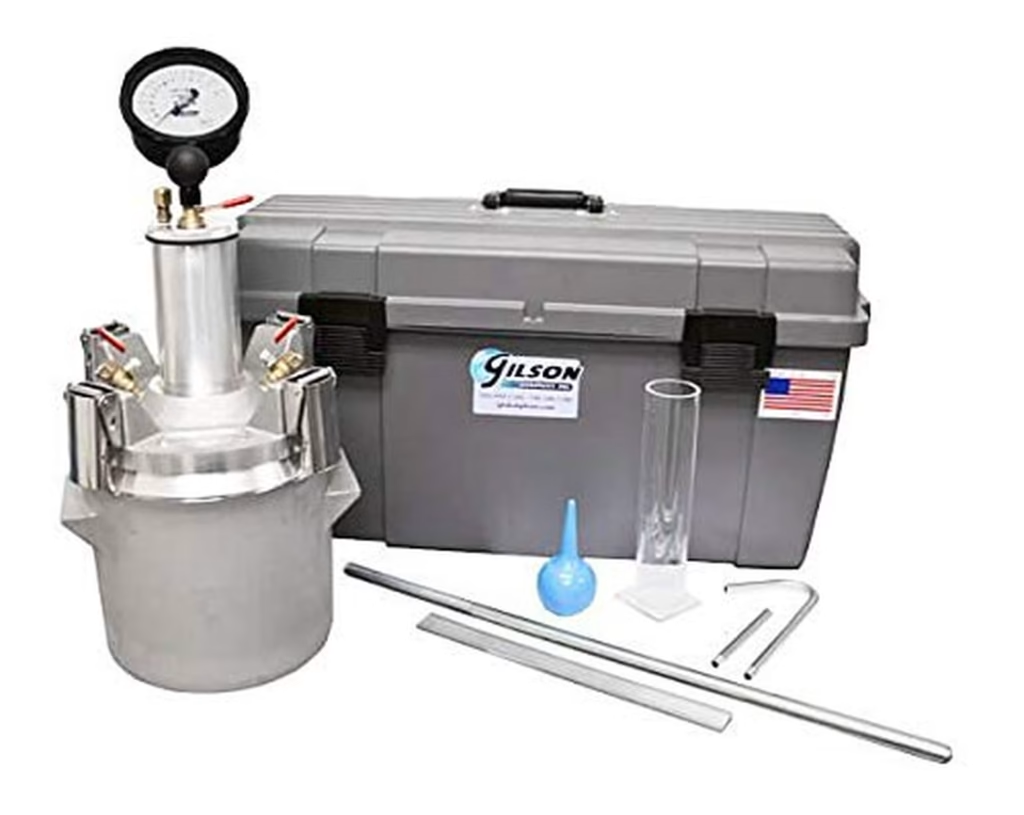
The pressure method relies on Boyle’s law: for a fixed mass of air at constant temperature, pressure times volume is constant. The measuring bowl of known volume is filled with freshly rodded concrete and struck off. The cover is clamped on, a little water is added through the valves, and the air chamber above the concrete is pressurised to a fixed initial pressure. Opening the valve lets the pressurised air expand into the volume occupied by entrained air in the concrete; the drop in equilibrium pressure is read on a dial calibrated directly in percent air. Two designs are common: the Type A meter uses a sight tube and water displacement and is suited to a wider range of bowl sizes, while the Type B meter, the most common field instrument, uses a self-calibrating air chamber and a direct-reading dial, and is the workhorse described in many field methods. ASTM C231 is limited to concretes made with relatively dense aggregates; concrete with lightweight aggregate, air-cooled blast-furnace slag or highly porous aggregate traps air inside the particles themselves, which the pressure method cannot distinguish, so it must be tested by the gravimetric or volumetric methods instead.
The European standard EN 12350-7, referenced by the iTeh catalogue entry for EN 12350-7:2019, describes two pressure-family methods for compacted fresh concrete made with normal-density aggregate. In the water-column method, water is introduced to a set height above the sample in a sealed vessel and a defined air pressure is applied over the water; the reduction in volume of the air in the concrete, read from the change in water-column height, is calibrated to percent air. In the pressure-gauge method, a known volume and pressure of air is combined with the air in the sample and the resulting equilibrium pressure is read on a dial calibrated in percent air, which is the same physical principle as the Type B meter. The container must be a rigid metal vessel of nominal capacity at least 5 litres with a height-to-diameter ratio in a defined range, and it must suit the maximum aggregate size of the mix. ISO 1920-2, the international test method for fresh concrete, specifies the same pressure-gauge and water-column determinations, so the two standards families give comparable results for the same mix.
The gauge dial is only as good as its calibration. Meters are checked with a calibration vessel that introduces known volumes of air, and the dial reading is verified against that known volume. The aggregate correction factor is a separate, often-missed step: even dense, normal-weight aggregate contains small voids that release air under pressure, so the raw reading must be corrected by measuring the apparent air content of the combined aggregate and water used in the mix, and subtracting it. Temperature matters too: very hot or very cold concrete, and a meter left in direct sun, shift the pressure-volume relationship; operators should shade the instrument, keep it near the concrete temperature, and follow the standard’s guidance on temperature correction or repeat the check. Gauge glasses, valves and O-rings need to be checked for leaks, because a small leak ruins the equilibrium pressure reading.
Warning: never accept a field air reading without the aggregate correction factor applied. A correction factor of 0.5 to 1.0 percent is typical for dense aggregate, and forgetting it systematically overstates the entrained air and can hide a mix that is actually under-air-entrained.
| Symptom | Likely cause | Check / corrective action |
|---|---|---|
| Reading higher than the mix design | Not applying the aggregate correction factor, or over-rodding entrained bubbles | Apply the correction factor; rod consistently with the standard’s layer count |
| Readings drift or never settle | Leaking valve, O-ring or gauge connection | Pressure-test the assembled meter; replace seals |
| Gauge reads off at calibration check | Out-of-calibration dial or damaged gauge | Re-calibrate with the calibration vessel before further acceptance testing |
| Air drops sharply from truck to truck | Admixture loss during transport, hot weather or retempering with water | Check admixture dosage and transit time; forbid retempering that changes air |
| Method not applicable to the mix | Lightweight or porous aggregate in the mix | Switch to the gravimetric or volumetric method for that mix |
Start with the method your contracts specify: ASTM C231 work generally calls for a Type A or Type B pressure meter, while EN 12350-7 work requires a vessel meeting its capacity and geometry requirements. Choose the bowl capacity to match your maximum aggregate size, because a bowl too small for the aggregate over-weights the mortar fraction. The dial should be large, clearly graduated and protected, and the meter should come with the accessories the standard expects: a tamping rod, a strike-off bar or straightedge, a syringe for adding water, a mallet, and the calibration vessel or tubes for field verification. Check that seals and valves are replaceable, that the manufacturer’s calibration certificate is included, and that the meter can be re-calibrated on site. Materst supplies Type A and Type B concrete air content meters, calibration vessels and fresh-concrete testing equipment for ready-mix plants and quality control laboratories worldwide.
Air content testing is a small test that protects against a large and expensive failure mode: the freeze-thaw scaling of concrete that was never given enough entrained air. The pressure method of ASTM C231 and the water-column and pressure-gauge methods of EN 12350-7 rest on the same simple Boyle’s-law principle, and they give dependable answers when the meter is calibrated, the aggregate correction factor is applied, and the mix is rodded and struck off exactly as the standard prescribes. Run the check at the jobsite against the exposure-based target, keep the temperature in mind, and the air meter remains one of the most cost-effective durability tools in the concrete laboratory.
Sources and references
- ASTM C231/C231M, Standard Test Method for Air Content of Freshly Mixed Concrete by the Pressure Method — ASTM International
- EN 12350-7:2019, Testing fresh concrete — Part 7: Air content — Pressure methods (iTeh Standards catalogue entry)
- ISO 1920-2:2016, Testing of concrete — Part 2: Properties of fresh concrete (ISO Online Browsing Platform)
- ASTM Subcommittee C09.60 on Testing Fresh Concrete (current standards list)