
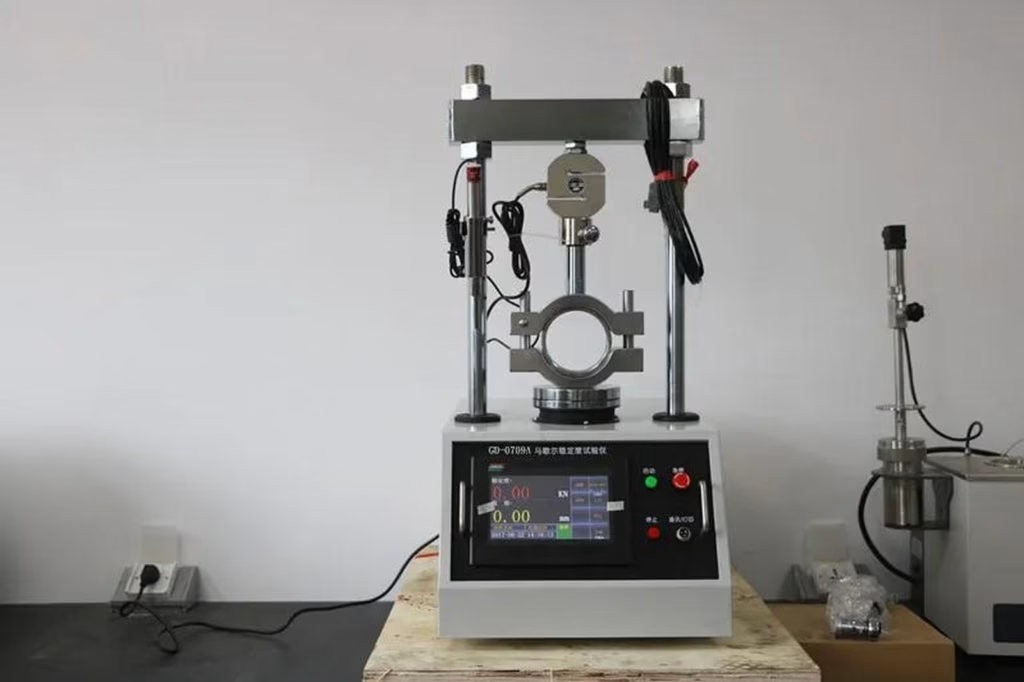
The Marshall stability test measures the maximum load a compacted asphalt specimen can resist before failure and the vertical deformation, or flow, it undergoes at that load. Together those two numbers have decided the acceptance of dense-graded asphalt mixes in laboratories around the world for more than seven decades. For mix design laboratories, plant quality control teams and road authorities, the test remains one of the fastest ways to check whether a mix has the stiffness and cohesion to survive heavy traffic without permanent deformation. This guide covers the procedure defined by ASTM D6926 and ASTM D6927, the typical acceptance values used in mix design, the faults that produce misleading results, and what to look for when buying a Marshall test machine.
Stability is the resistance of the compacted specimen to plastic flow, reported as the peak load recorded while the specimen is loaded radially, perpendicular to the cylindrical axis, through the Marshall breaking head at a constant rate of 50 mm/min. Flow is the total deformation of the specimen, elastic plus plastic, measured from the point where the projected tangent of the linear part of the load curve intersects the deformation axis to the point where the curve becomes horizontal, which normally corresponds to the peak load. A mix with adequate stability carries load without excessive deformation; a mix with excessive flow under load is described as tender and prone to rutting or shoving, while a mix with very low flow is often brittle and prone to cracking.
The method was developed by Bruce Marshall of the Mississippi State Highway Department in the 1940s and later refined by the US Army Corps of Engineers and the Asphalt Institute, which embedded it in the widely used MS-2 mix design manual. The former ASTM D1559 was withdrawn and replaced by the pair ASTM D6926 (specimen preparation) and ASTM D6927 (stability and flow), and the method also exists as AASHTO T245 and in many national standards, for example T 0709 in China’s JTG E20 specification. Even where Superpave gyratory compaction is the primary design tool, Marshall testing is still routinely specified for field quality control, smaller paving projects and for verifying that plant-produced mixes match the design job mix formula. The result is that a large share of the world’s asphalt laboratories, including plant labs in remote locations, still rely on the Marshall apparatus as their core piece of acceptance equipment.
Note: if you inherit an older machine labelled “ASTM D1559”, the test itself has not changed in principle, but current specifications reference D6926 and D6927, so documentation, calibration certificates and job specifications should be updated to the current standards.
Specimens are cylindrical, 101.6 mm in diameter and nominally 63.5 mm high, prepared from laboratory-mixed or plant-produced asphalt mixture with aggregate up to 25 mm maximum size. The mixture is compacted with the Marshall hammer, a 4.535 kg hammer with a free fall of 457 mm striking a steel compaction foot, on a stable pedestal. The number of blows per face is set by the practice for the design traffic level, typically 35, 50 or 75 blows on each face. Specimens are compacted from both ends, allowed to cool, and their bulk specific gravity is determined before testing. Agencies often publish their own working instructions that add practical detail to the standard, such as the Government of Alberta’s ATT-13 procedure for forming Marshall specimens, which specifies the wide-mouth funnel, extrusion jack and compaction pedestal installation. Consistent compaction energy is the single biggest factor controlling whether the measured stability reflects the mix or the operator.
- Condition the compacted specimen in a water bath at 60 ± 1 °C for 30 to 40 minutes for 101.6 mm specimens.
- Remove the specimen, wipe the surface dry and place it in the lower segment of the breaking head.
- Position the assembly in the loading frame and apply load at a constant rate of 50 mm/min.
- Record the maximum load, which is the stability value.
- Record the flow, the deformation at maximum load, from the flow gauge or digital displacement transducer.
- Apply the correction factor for specimen height given in the standard, then average the replicate results.
The test is fast once specimens are prepared, which is exactly why it suits plant quality control: a full set can be compacted, conditioned and tested within a working day. Because results depend strongly on conditioning temperature and loading rate, the bath thermometer and the loading rate of the frame both need periodic verification, otherwise the same mix will pass in one laboratory and fail in another.
Marshall stability and flow are not interpreted in isolation. Mix design specifications normally set minimum stability, a flow window, and requirements for air voids, voids in mineral aggregate (VMA) and voids filled with asphalt (VFA). The Asphalt Institute’s MS-2 manual publishes typical criteria by traffic level, summarised below; always confirm the exact values against the governing contract specification, because agencies adjust them for local materials and climate.
| Property | Light traffic | Medium traffic | Heavy traffic |
|---|---|---|---|
| Min. stability (kN) | 3.3 | 5.3 | 8.0 |
| Flow (mm) | 2–4 | 2–4 | 2–4 |
| Air voids (%) | 3–5 | 3–5 | 3–5 |
| Min. VMA (%) | 12–16 (by NMAS) | 12–16 (by NMAS) | 12–16 (by NMAS) |
| VFA (%) | 75–85 | 70–80 | 65–78 |
Reading the pair of values together is more informative than checking each against a limit. High stability with very low flow suggests a stiff, brittle mix, often too hard a binder or insufficient binder content. Low stability with high flow points to excess binder, a soft binder grade or an under-compacted specimen. A mix that meets every individual limit but sits at the extremes of the stability-flow ratio should be reviewed against rutting and cracking performance before approval.
| Symptom | Likely cause | Check / corrective action |
|---|---|---|
| Low stability across all replicates | Insufficient compaction energy, cold compaction, or degraded aggregate | Verify hammer drop is 457 mm and blow count matches D6926; reheat and recompact at the specified mixing temperature |
| High variability between laboratories | Bath temperature drift or loading rate out of tolerance | Calibrate the bath thermometer; verify loading rate is 50 mm/min |
| Flow reading jumps during test | Flow gauge zero drift or loose gauge mounting | Zero the gauge before every test; check mounting and annual calibration |
| Stability differs between the two faces of the same specimen | Unequal compaction energy per face or damaged pedestal | Follow the specimen flipping sequence; inspect the compaction pedestal plate |
| Binder drain-down or sticking to the mold | Mix too hot or excess binder | Reduce mixing temperature; verify binder content against the job mix formula |
Capacity is the first decision: 25 kN covers standard Marshall testing, while a 50 kN frame also handles the heavier specimens used in some national methods. Load measurement is either a proving ring with dial readout or, on modern machines, a load cell with a digital display that holds the peak value automatically; flow is captured by a dial gauge or a digital displacement transducer with automatic peak-flow capture. A motorized frame maintains the constant 50 mm/min loading rate, and the frame should be verifiable to ASTM E4 so that its force indication can be certified. Data logging over RS232 or USB, a large display, and dual breaking heads that accept 101.6 mm and 152.4 mm specimens all reduce operator effort in a busy plant laboratory. Materst supplies Marshall stability testers together with water baths, compaction hammers, molds and full asphalt laboratory packages for mix design and quality control laboratories worldwide.
The Marshall test survives because it is simple, fast and directly connected to the two properties that matter in service: the ability to carry load and the tendency to deform. But simplicity is deceptive: temperature, compaction energy and loading rate all shift the numbers, which is why the test only earns its reputation when the procedure is followed strictly and the equipment is calibrated. Buy the machine with verified force indication, run it by the standard, and read the stability and flow values together against the project specification, and the Marshall apparatus will keep delivering dependable mix decisions for decades.
Sources and references
- ASTM D6926-20, Standard Practice for Preparation of Asphalt Mixture Specimens Using Marshall Apparatus — ASTM International
- ASTM D6927, Standard Test Method for Marshall Stability and Flow of Asphalt Mixtures — ASTM International
- ASTM Subcommittee D04.20 on Mechanical Tests of Asphalt Mixtures (current standards list)
- Government of Alberta, ATT-13: Forming Marshall Specimens — departmental procedure
- ASTM International News — Standards and the Summer Driving Season (background on D6926/D6927)